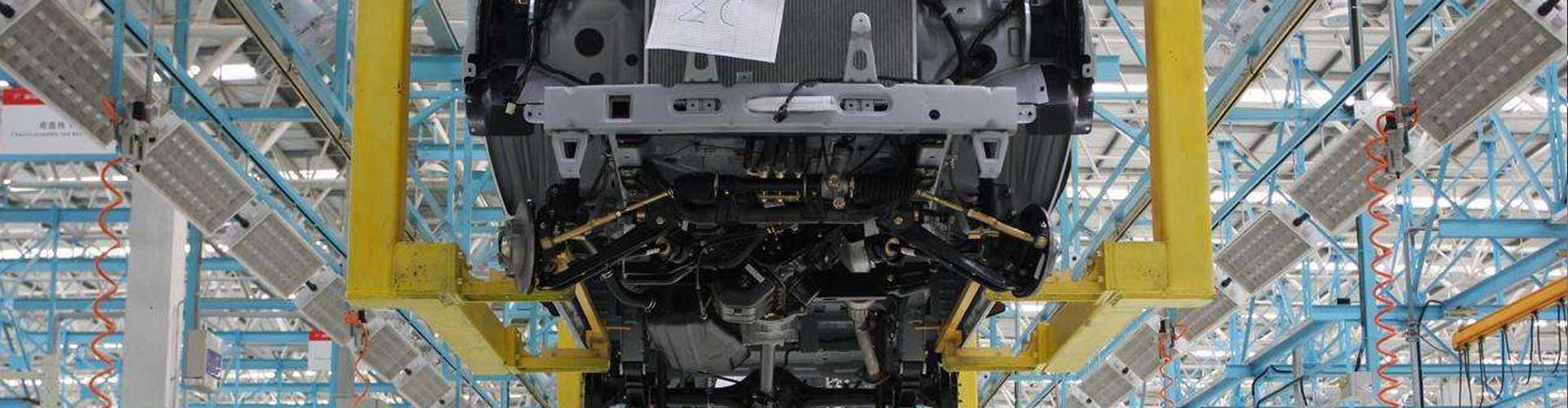
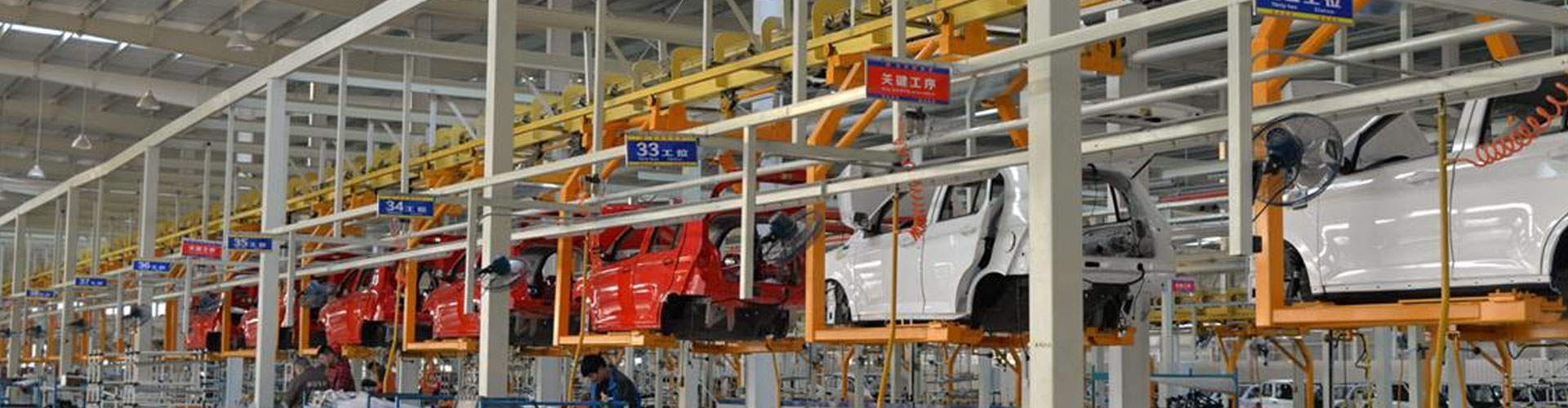
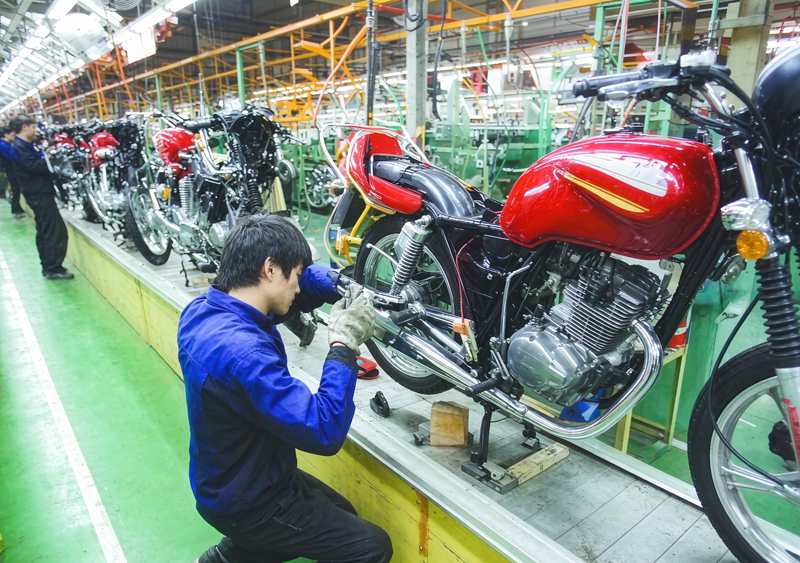
This two-wheeler motorcycle final assembly line is developed for mass assembly scenarios of fuel-powered standard motorcycles, scooters, retro motorcycles and electric two-wheeler complete vehicles. It belongs to non-standard complete vehicle conveying and assembly equipment for motorcycle OEMs and serves as the core main production line for mass production of two-wheeled motor vehicles. The entire motorcycle production line arranges workstations strictly in accordance with the forward assembly process logic of two-wheeler motorcycles. It fully covers a full set of standard mass-production procedures: frame loading, centralized pre-assembly of components, chassis system marriage, engine/motor powertrain assembly, installation of instrument panels and vehicle wiring harnesses, wheel assembly, filling and replacement of all vehicle fluids, static functional commissioning of complete vehicles, and full inspection before off-line. The equipment supports flexible mixed-model production for multiple vehicle types and enables fast switching between models with different frames, power systems and configurations. It fully meets the standardized, large-scale and continuous mass production requirements of small and medium-sized motorcycle manufacturers, and effectively improves assembly consistency of finished vehicles and production delivery efficiency.
Main Conveyor Slat Line
As the core load-bearing and conveying mechanism of the complete motorcycle assembly line, it adopts an industrial heavy-duty slat conveying structure featuring high structural strength and abundant load margin. It can stably carry motorcycle frames and semi-finished vehicles for continuous flow operation for a long time. The line is equipped with customized adjustable tooling and support fixtures, which can quickly perform positioning according to the wheelbase and frame mounting points of different models. It effectively prevents frame offset, shaking and misalignment during assembly and guarantees assembly accuracy at each workstation. The full-line electrical system supports precise station stop, segmented speed regulation conveying and emergency stop interlock protection. It delivers stable operation with low failure rate and adapts to continuous mass production conditions in factories.
Pre-assembly Auxiliary Workstation Module
The production line is equipped with standardized split-type pre-assembly auxiliary workstation modules, including core sub-assembly units such as frame pre-assembly bench, front and rear shock absorber assembly pre-assembly station, engine powertrain pre-assembly station and steering system pre-assembly station. Large-volume components with complicated procedures and long operation time are pre-assembled, pre-fitted and pre-tightened offline in advance. After self-inspection, they are transferred to the main line for integrated marriage. This design reduces the workload of the main assembly line, eliminates process accumulation and man-hour waste, precisely balances the takt time of the whole motorcycle production line, improves the Overall Equipment Efficiency (OEE) of the line, and adapts to stable and efficient assembly line mass production mode.
Assembly Auxiliary System
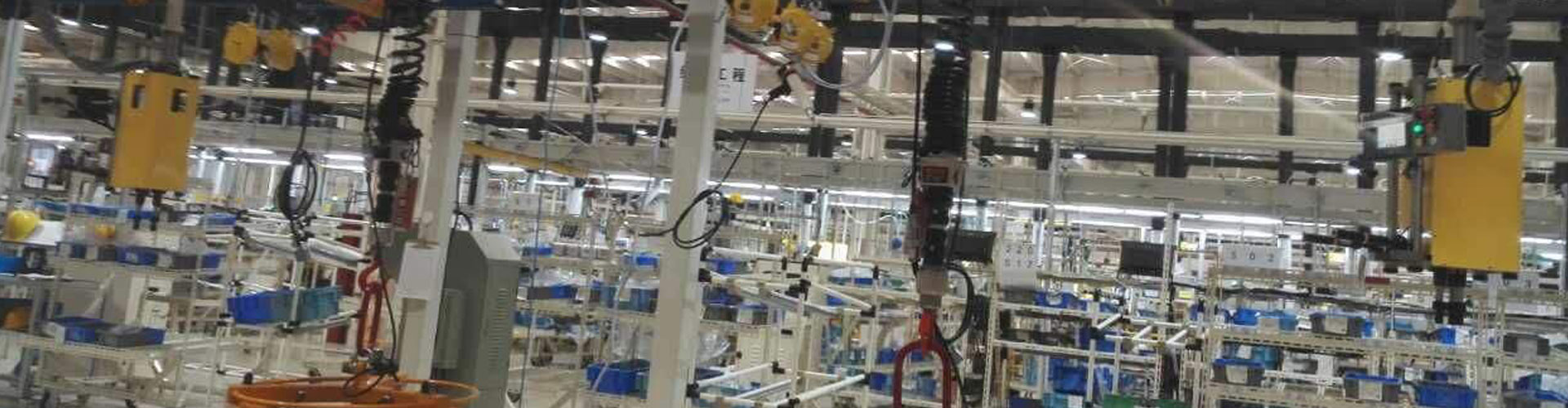
Each workstation of the motorcycle assembly line is equipped with standardized industrial assembly auxiliary systems, including hanging slide rails for pneumatic tools, retractable hose reels, stabilized air supply pipelines and workstation material sliding tables. A spiral retractable air supply structure is deployed on site to provide continuous and stable air supply for pneumatic torque wrenches, pneumatic tightening guns and other assembly tools at each station, adapting to high-frequency and high-intensity assembly work. Multi-layer material racks are set up at workstation areas for nearby storage and picking of parts, reducing operators’ movement and material searching time. It complies with lean production layout standards and improves assembly efficiency and operation standardization at individual stations.
Final Vehicle Inspection & Offline Section
The end of the production line integrates an all-in-one final vehicle inspection and offline section. It implements factory inspection procedures including power-on functional inspection of complete vehicles, brake system performance verification, lighting and instrument functional test, pipeline sealing and fluid leakage test. Multi-dimensional functional verification is carried out on assembled complete vehicles to ensure all key systems including vehicle electrics, braking, oil circuits and instruments function normally and meet parameter specifications. Vehicles passing inspection will directly complete offline transfer. For defective vehicles with assembly defects or abnormal functions, an independent rework branch channel is configured. This separated operation mode realizes smooth flow of qualified products and isolated rework of non-conforming units, effectively ensuring the pass rate of finished products.
Multi-model Flexible Compatibility
This motorcycle production line adopts flexible modular design. Station tooling, positioning fixtures and assembly reference benchmarks support rapid model change and adjustment. It can quickly switch between standard motorcycles, scooters, retro motorcycles, electric two-wheelers and other models, and offers good adaptability to vehicles with different track widths, wheelbases and frame structures. A single motorcycle assembly line can realize mixed alternate production of multiple varieties and small batches. There is no need to repeatedly build new production lines, which effectively reduces fixed asset investment and operation & maintenance costs for vehicle manufacturers.
Heavy-duty Reliable Structural Design
Considering the industry working conditions of concentrated assembly load and continuous production of two-wheeler motorcycle frames, the slat chain, main support frame and bottom load-bearing base of the line are reinforced with load margin design. It has strong structural rigidity and excellent deformation resistance. The line can adapt to 24-hour non-stop shift production in factories. Under long-term heavy-load operation, the line runs without deformation or shaking and maintains smooth conveyance, highly matching the high-intensity continuous mass production schedule of motorcycle manufacturing.
Customizable Workstation Takt Time
The equipment can carry out refined process man-hour breakdown and workstation takt planning according to customers’ actual production capacity targets and workshop manpower allocation. The standard designed cycle time is controlled within 4~12 minutes per unit. The full-line capacity can accommodate annual production plans of 20,000 to 200,000 motorcycle units. Meanwhile, the entire motorcycle production line can be customized with non-standard layout based on customers’ existing workshop dimensions, site layout and inlet/outlet positions. It supports linear, return-type and other layout options with strong site adaptability.
Safety Interlock & Electrical Control
The whole line is equipped with an industrial-grade safety protection system. Emergency stop buttons, safety guardrails and infrared photoelectric protection devices are installed at each workstation. Automatic alarm and shutdown protection will be triggered for fault conditions such as part shortage and line jamming to eliminate safety hazards. The whole line adopts centralized PLC programmable control system with stable operation logic. It can seamlessly connect with factory MES manufacturing execution system to realize real-time collection of workstation production data, automatic output counting, real-time monitoring of equipment status and traceability management of production data, meeting intelligent production management requirements of modern vehicle factories.
Widely applied in fuel motorcycle manufacturing plants, electric two-wheeler OEMs and motorcycle mass production bases. It also fits technical renovation and capacity expansion projects for motorcycle manufacturers. It can be used for overall construction of new motorcycle production lines, equipment upgrade of old motorcycle assembly lines, takt optimization of production lines, standardized transformation of manufacturing processes and other engineering projects.
The production line supports modular function expansion. Customers may select optional value-added modules according to production capacity and process requirements, including frame overhead conveyor line, body painting transfer conveyor, automatic tire assembling machine, automatic filling equipment for all vehicle fluids, complete vehicle rain tightness test line, AGV intelligent material handling system, so as to further improve the automation level and overall mass production capacity of the line.
Previous: Electric bicycle assembl...
Next: Electric Bicycle Product...